
An oil-injected screw compressor carries some oil downstream in the form of liquid, aerosol, and vapour. This requires careful planning of the installation of downstream oil removal and gas conditioning systems before the gas enters the process. This is performed by filtration and chilling.
The International Organization for Standardization (ISO) specifies the oil contaminant acceptable in compressed air system and the same is available in their standard ISO 8573-1 which is listed below:-:
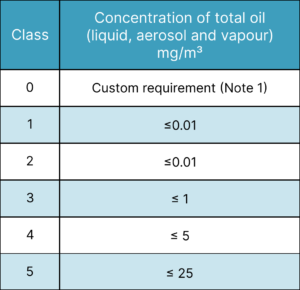
Note 1 : As specified by the equipment user or supplier and more stringent than class 1.
Filtration downstream air/gas in oil injected screw compressor considers different types of contamination. They are:-
- Solid removal – Usually come from pipe scales and dirt from installation.
- Liquid – Could be water but in majority of cases oil from compressor itself.
The liquid oil can appear as large droplets or very fine particles which are known as aerosols.
These aerosols are typically in the range of 0.01µ to 0.8µ. They are created by high shearing action of compressor rotors.
The amount oil vapour in a gas depends on many factors
-The type of oil
-Temperature
-Pressure
-The gas itself
-Age of the oil
-Type of system.
So let us go into the details of oil removal system at downstream of the compressor with help of flow path below:-
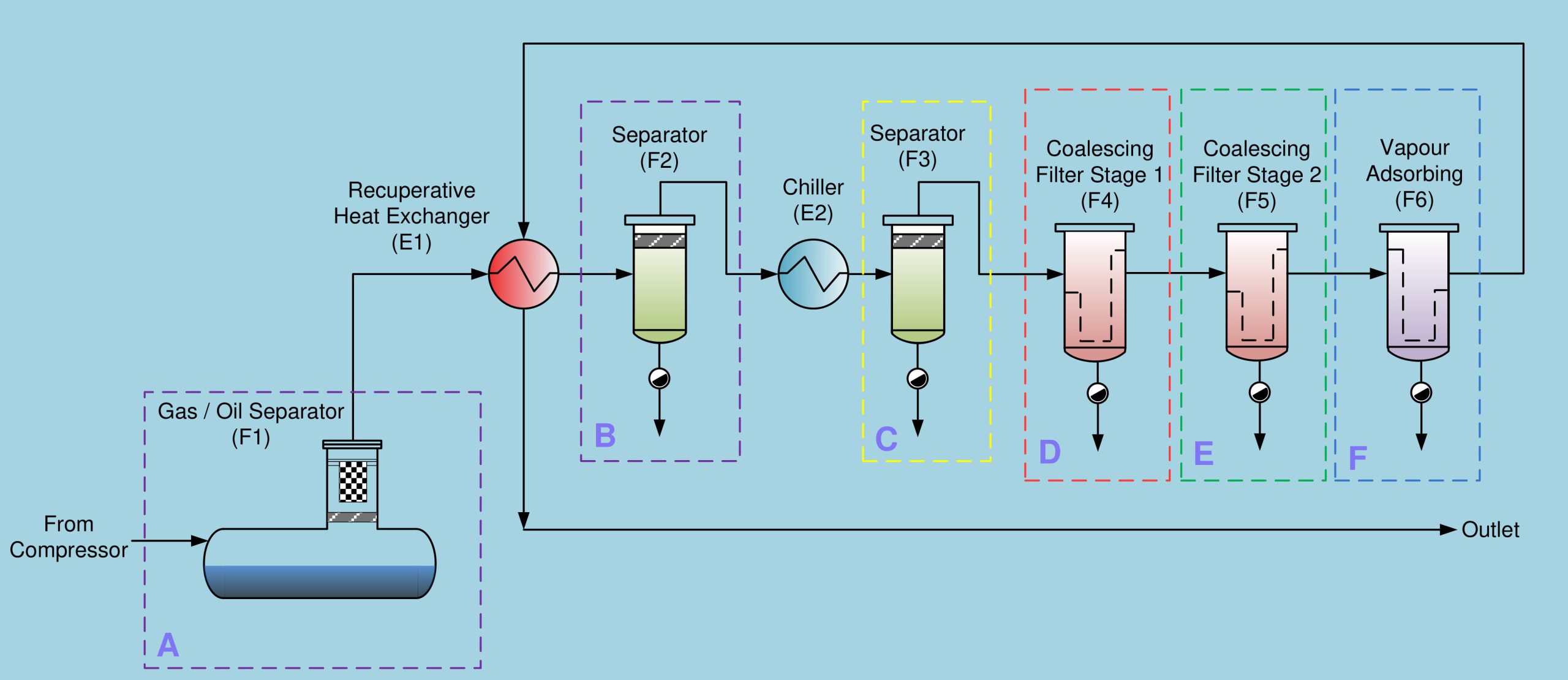
Let us understand the above flow path in section wise into the details:
1. Section A – The Section A is Gas / Oil separator tank with mist pad and borosilicate filter. Compressors are designed with an outlet temperature of 90°C to 110°C. This temperature is determined by the moisture / hydrocarbon dew point of the air/gas at the discharge pressure of the compressor.
The curves for oil vapour carryover using Kluber Summit oil is given below (Figure 2.1 & 2.2). These are Polyalphaolefin (PAO) based oil which is used for gas screw compressor. Using Dalton’s Law of Partial Pressures, the maximum amount of oil vapour in the system under the given conditions is calculated as follows:-

Where,
M1 is the molecular weight of the oil
M2 is the molecular weight of the gas
P1 is the oil vapour pressure at operating temperature
P2 is the gas pressure (system pressure)
Note: P1 and P2 are in absolute pressure in the same units of measurement.
Let us analyse the vapour carryover at various temperature at the outlet of gas / air separator for a gas with a molecular weight of 28.965.
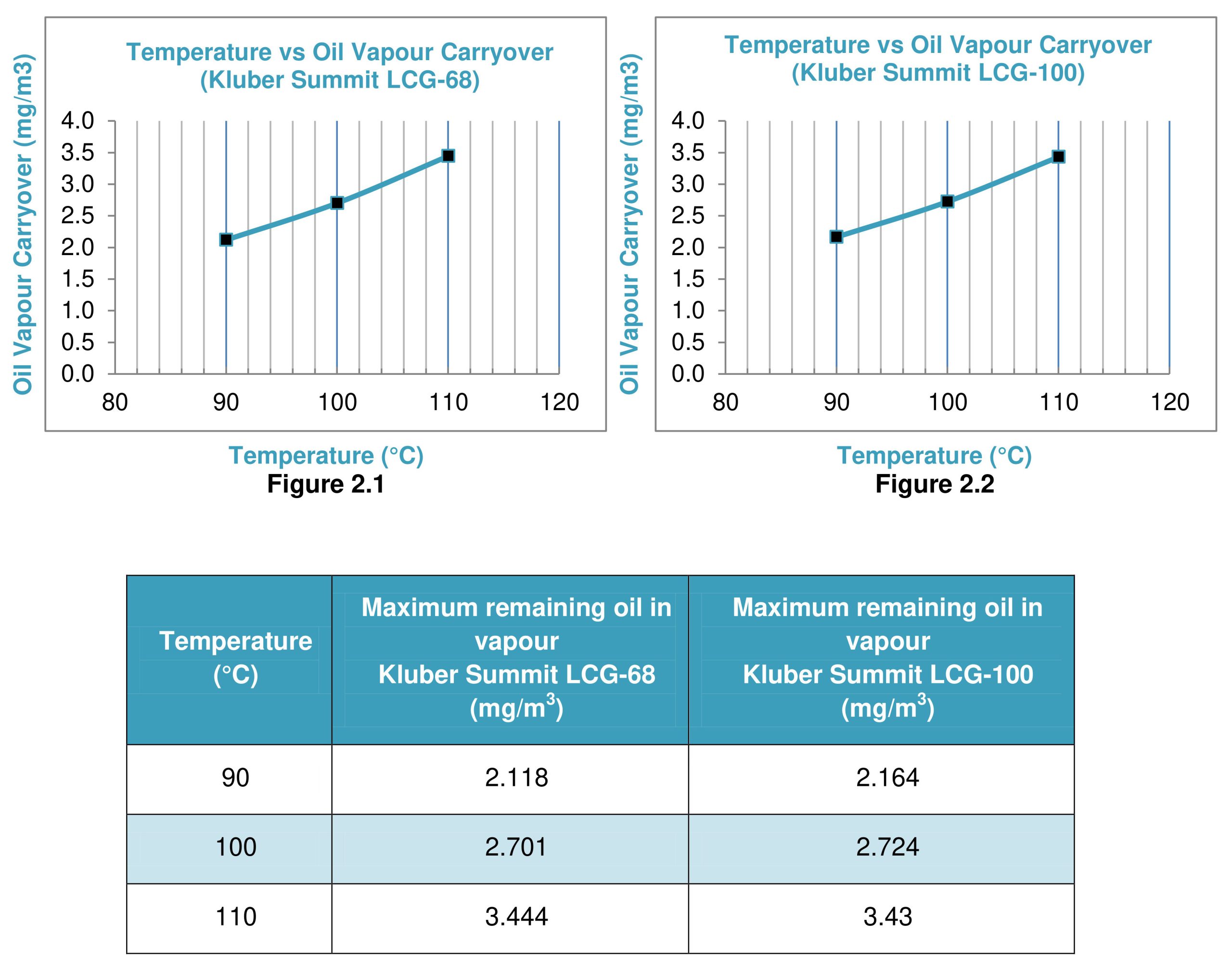
These results clearly demonstrate that oil vapour carryover steadily rises with temperature. At higher operating temperatures, more oil particles and vapour are present in the gas stream due to the increase in oil volatility and vapour pressure.
Here the borosilicate coalescing cartridge of maximum oil aerosol carryover 3 mg/m3 is used as a standard.
Now the remaining oil is present in vapour form and cannot be removed in the gas/oil separator. So to reduce this, the gas/air must be chilled to reduce the vapour pressure and force condensation.
2. Section B – Section B is to remove the condensate which may come out of the recuperator depending on the gas properties and the temperature. The separation is of mist pad type.
3. Section C – Now the gas is chilled down to lower temperature depending upon the vapour carryover required. Curve below shows the vapour carryover at various temperatures:-
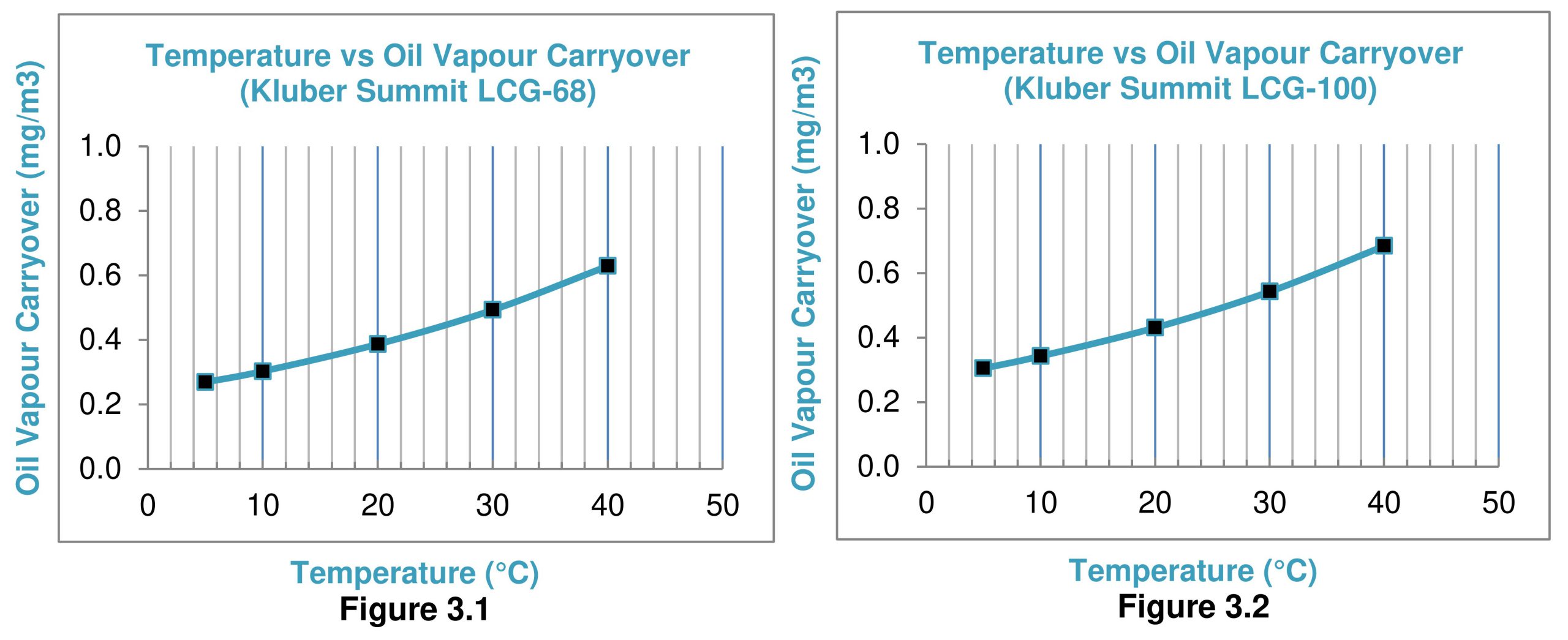
From the above it is clear that oil vapour carrying capacity goes down with temperature. The chilling temperature is determined to reduce the vapour removal load which will come later.
The bulk liquid condensate is removed by mist pad separator. However for final removal of aerosols we have to install borosilicate depth filters.
4. Section D – Here a general purpose coalescing filter is used for removing residual oil droplet and aerosol.
Maximum remaining oil aerosol content:- 0.78 ppm w/w (0.924 mg/m³) at 20 °C. (For higher temperature please consult).
5. Section E – The high efficiency coalescing filter is used for removing oil aerosol.
Maximum remaining oil aerosol content:- 0.01 ppm w/w (0.01 mg/m³) or lower at 20 °C. (For higher temperature please consult).
6. Section F – Now to go down in oil content, we will have to remove oil in vapour form. This is done either by a specially designed vapour adsorbing cartridge or a bed of suitable activated carbon.
Maximum remaining oil vapour content after this will be 0.01 ppm w/w (0.01 mg/m³) at 20 °C. (For higher temperature please consult).
The oil vapour load to the vapour adsorbing filter / activated carbon bed can be found out from the figure 3.1 & 3.2 and we can reduce the load by chilling to a lower temperature.
Example:-
Oil vapour recommended at the membrane inlet by various membrane manufactures:
One of the European membrane manufacturers specifies that the membrane inlet gas should have oil content as per ISO 8573-1, Class 1 means ≤ 0.01 mg/m³, total oil: liquid, aerosol, vapour.
One of the Japanese membrane manufacturers specifies that the membrane inlet gas should have an oil content of 0.008 ppm(v), which corresponds to 0.0103 ppm(w) (0.012 mg/m³). So as per ISO 8573-1, Class 1 will be applicable.
This contaminant gets easily condensed in the hollow fiber membrane due to their high boiling points, and the condensed contaminants can cover the membrane surface, obstructing gas permeation.