
Membrane-Based Biogas Upgrading
Why the Same Inlet Flow Can Mean Two Different Plants
CBG plants operate with widely varying feedstocks and digester configurations including press mud, cattle dung, agricultural residues and municipal solid waste. By the time raw biogas reaches the upgrading skid, each feedstock and process configuration can result in a different gas composition, moisture content and contaminant profile.
At its core, a membrane-based Biogas Upgrading Plant (BUP) must answer a fundamental question: for a defined inlet flow and gas composition, how much upgraded biomethane will the plant actually deliver and what will that mean in TPD?
Design Basis, Made Unambiguous
Both charts use the same five design points 500, 750, 1000, 1250, and 1500 Nm³/hr but that number represents something different in each case:
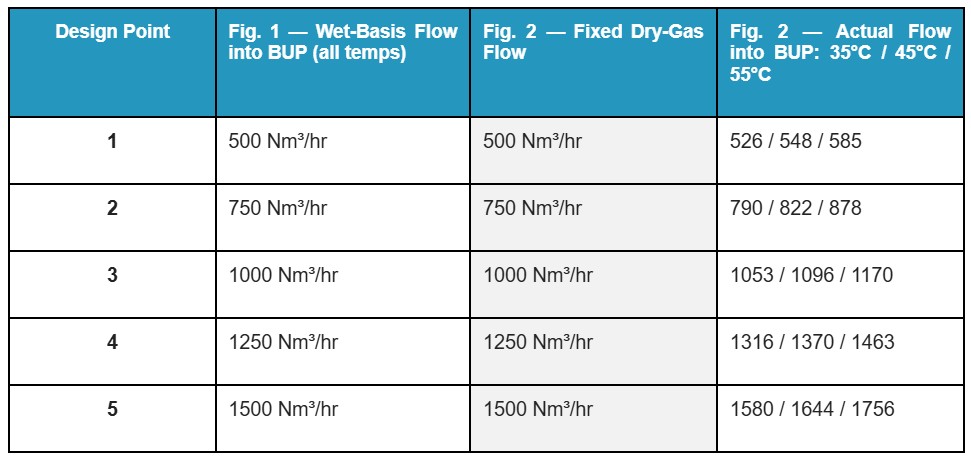
entering the BUP is higher and increases further as the temperature rises, because moisture is added to the dry gas at each temperature. In short: Fig. 1 fixes the total (wet) flow while allowing the dry-gas share to vary; Fig. 2 fixes the dry-gas flow while allowing the total (wet) flow to vary.
All other inputs 96% outlet methane purity, 97% recovery, 9–13 barg outlet pressure, 0 barg inlet pressure, and 28.71 inlet molecular weight are held constant across both cases.
Wet Basis: Same Number, Less Dry Gas as Temperature Rises
When inlet flow is quoted on a wet, fully saturated basis, the stated flow already includes water vapour. As temperature rises, saturated gas holds more moisture; therefore, within the same stated total flow, a larger proportion is water vapour and a smaller proportion is actual dry gas available for upgrading.
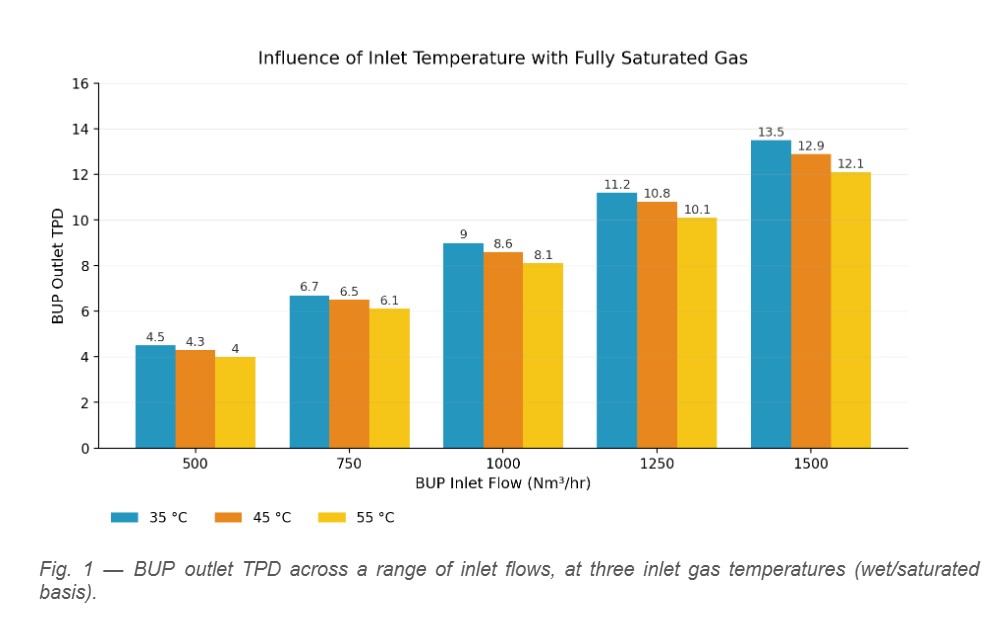
The trend repeats at every flow point: at 1,500 Nm³/hr, the plant delivers 13.5 TPD at 35°C but only 12.1 TPD at 55°C a swing of roughly 10%, driven purely by temperature. Nothing about the membrane or the feedstock changed. What changed was how much of that “1,500” Nm³/hr was actually dry gas and how much was water vapour.
Warm, saturated gas carries more water vapour per cubic metre. That water occupies part of the inlet flow that is not methane or CO₂, so less usable dry gas enters the BUP and less upgraded gas comes out, even though the flowmeter reads exactly the same value.
Dry Basis: Same Gas, More Flow to Carry the Moisture
A dry-basis flow specifies only the actual gas components methane, CO₂, oxygen and so on with water vapour excluded entirely. So, a 1,000 Nm³/hr dry-basis design point means 1,000 Nm³/hr of dry gas, whether that gas arrives at 35°C, 45°C, or 55°C.
What changes with temperature is the moisture load carried alongside it: the total wet flow entering the BUP increases, but the dry-gas quantity and therefore the methane available for upgrading remains fixed.
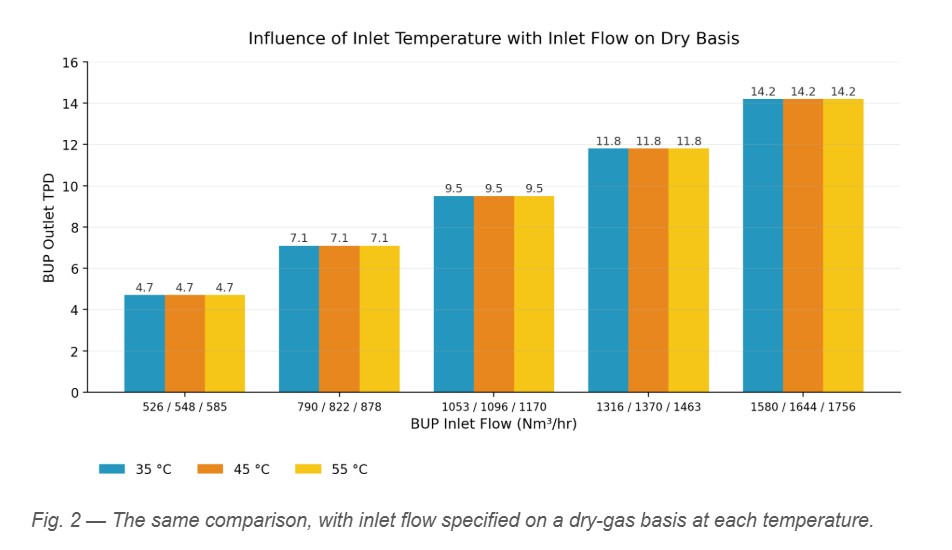
That is why the outlet TPD remains essentially steady across all three temperatures at every design point in Figure 2. Temperature still changes the moisture load and the total wet flow, but it does not affect the fixed quantity of dry gas on which the BUP design is based.
The Real Design Aim: Outlet TPD, Traced Back to Inlet Flow
Both charts point to the same underlying goal: determining the outlet TPD a BUP will deliver for a given inlet flow accurately, not just nominally. That relationship is what a BUP is actually sized against, and it only holds when the inlet basis is clearly defined.
At GPE, our BUP designs treat the inlet basis wet or dry, temperature, pressure, and molecular weight as a first-class design input. This ensures that the outlet TPD we quote reflects the outlet TPD the plant can actually deliver, regardless of which digester or feedstock is supplying the gas.